Samstag, 18. August 2012

sprichwort der woche: wenn die katze aus dem haus ist, tanzen die mäuse auf dem tisch

Wenn die Katze aus dem Haus ist, tanzen die Mäuse auf dem Tisch.


I have plenty of experience of this proverb, in its literal sense.
Let's look at it word by word.

Wenn is simply when. A soundalike and lookalike word.

Die Katze is the cat.

Here aus dem Haus means out of the house.

The ist at the end of the first clause means is. So the first clause put together means: When the cat is out of the house.

The second clause begins with a verb: tanzen. This means dance.

Next we have another animal - die Mäuse. The mice.

And finally another preposition plus a place. Auf dem Tisch.  You might remember auf dem means on the: we had auf dem Dach a week or two ago. And Tisch is table.

The second clause means: the mice dance on the table.

The English equivalent of this old German proverb is When the cat's away the mice will play.

I live in an old house with plenty of tiny little gaps in the walls. Mice find it very easy to squeeze in and out of these gaps. A few years back when my dear old ginger cat Ollie died we were quite slow to find a replacement for him. Gradually we noticed increasing numbers of mice scurrying around the house. Gnawing their way through food containers and nibbling little holes into paper packages. As the winter got colder the mice got more numerous, and seemed quite well fed. We even hung Christmas chocolates up from the ceiling so the mice couldn't get at them. We now have a lovely sleek black cat who does an excellent job of keeping the mice at bay. Her name? Mouser!


Donnerstag, 9. August 2012

sprichwort der woche: eine schwalbe macht noch keinen sommer.

Datei:Hirundo rusticae.jpg
junge Nestlinge
I've found another German proverb that makes good sense to me. What I like about it is that it uses everyday language, like many proverbs, and continues with the bird theme I've started. Because I am a bit of a bird brain.

Eine Schwalbe macht noch keinen Sommer.


Eine Schwalbe
OK, the bird in question. Die Schwalbe ist etwa 17 cm lang. Der Rücken ist metallisch glänzend blau-schwarz. Die Unterseite ist rahmweiß. Die Schwalbe verbringt den Sommer in Europa und den Winter in Afrika.

Have you guessed what it is yet? You're right, it's a swallow.

macht 
This is an example of a word where German ch becomes k in English.There are a number of these, including Milch (milk), Buch(book), Koch (cook). Macht means makes.

noch keinen Sommer
You probably know that Sommer means summer. The noch keinen is a little trickier. Literally kein  means not a or none. And here noch is used to mean yet.

The whole proverb then means roughly one swallow makes not yet a summer.

The English equivalent of this proverb is one swallow doesn't make a summer. This wise old saying is generally used to warn people not to get too excited about the smallest hint of good things to come. Swallows usually arrive in Europe when the weather begins to get warmer at the end of spring. They come to Europe to breed and food is plentiful for them during our summer months. After the breeding season they fly with their young to Africa in search of warm weather and food. To find out more about swallows you could read Dear Olly by Michael Morpurgo, the story of a swallow called Hero and his journey of thousands of miles to catch up with his family. Are there any swallows' nests near where you live?

Still not sure how to identify a swallow? Look at this little clip of a female swallow looking after her young.


Dienstag, 7. August 2012

sprichwort der woche: der spatz in der hand ist besser als die taube auf dem dach

Drei junge Spatzen

Many German proverbs have a direct equivalent in English. Proverbs are short and well known sayings and usually  they are very old and nobody is quite sure about their origin.

Look at this German Sprichwort (proverb).

Der Spatz in der Hand ist besser als die Taube auf dem Dach.


Der Spatz is a common bird in Germany as well as Britain. Small and brown with a cheerful call ,you may already have guessed it is a sparrow. So der Spatz in der Hand is the sparrow in the hand.

The next part of the sentence ist besser als is one of those German phrases that sound very like what they mean in English. Ist  means is; besser means better; and als means than.

Another common bird is die Taube. Visitors to British cities can see dozens of these birds, and Trafalgar Square in London is known for its huge numbers. They are large and grey and their call is like a soft hooting. Yes, eine Taube is a pigeon.

Now we come to auf dem Dach. This simply means on the roof.

So literally our German proverb means The sparrow in the hand is better than the dove on the roof. In English we have a very similar proverb - A bird in the hand is worth two in the bush.

Both proverbs mean roughly the same thing; it is better to have something for certain than to try and get something which may be more valuable if it is out of your reach.


Freitag, 3. August 2012

die olympischen Sommerspiele

This alphabetical list of the Olympic sports played in the summer games is in German. How many can you name in English?

  • Badminton
  • Basketball
  • Bogenschießen
  • Boxen
  • Fechten
  • Fußball
  • Gewichtheben
  • Handball
  • Hockey
  • Judo
  • Kanusport
  • Leichtathletik
  • Moderner Fünfkampf
  • Radsport
  • Reitsport
  • Ringen
  • Rudern
  • Schießen
  • Schwimmsport
  • Segeln
  • Taekwondo
  • Tennis
  • Tischtennis
  • Triathlon
  • Turnen
  • Volleyball
Look below to see if you were right.

Badminton Basketball Archery Boxing Fencing Football Weightlifting Handball Hockey Judo Canoeing Track and Field Modern Pentathlon Cycling Riding Wrestling Rowing Shooting Swimming Sailing Taekwondo Tennis Table tennis Triathlon Gymnastics Volleyball

For more information about Leichtathletik events click here.


Freitag, 20. Juli 2012

paul klee: burg und sonne

File:Burg und Sonne - Klee.jpg

Paul Klee was born in Switzerland in 1879. He trained as a painter in the Academy of Fine Arts, Munich. His father was a German music teacher and his mother a Swiss opera singer. Although he was trained musically and played the violin well he rebelled against his parents' wishes and decided to study fine art in Germany.

His style of painting was very distinctive. He liked to turn objects into simple geometric shapes when he painted them. As you can see, the above painting is made up of diamonds, squares, rectangles, triangles and one circle.

Klee's use of colour and shape makes his works very striking. I find the painting above Burg und Sonne (Fortress and Sun) quite compelling to look at.

Sonntag, 8. Juli 2012

word of the week: bratwurst

Are you a sausage-lover? If so a trip to Germany is right up your street! There are probably as many types of sausage as there are regions in Germany. Wikipedia lists 36 pages of sausage varieties and each page features a few sub-varieties.

Bratwurst is the most well-known sausage. There are over 40 different recipes for Bratwurst alone. The main ingredient is always chopped meat, usually pork, beef or veal, and flavoured with herbs and spices. The Nürnberger Rostbratwurst is similar in size to a British banger (whereas most German sausages are about twice the size) and is a pork sausage lightly seasoned with marjoram. They are traditionally grilled over a beechwood fire. In a pub they are served on a plate with plenty of delicious sauerkraut and eye-watering horseradish.

File:Bratwurst Glöckl.jpg


If you are in a hurry you can buy them from a street vendor at an Imbißstube. They are usually sold in threes inside bread rolls, slathered in hot German mustard.

File:Drei im Weggla.jpg


Recently Germans have acquired a taste for Currywurst. This is simple and filling fast food, German style. One pork sausage, steamed then fried, is cut into slices and served with generous amounts of warm curry ketchup. This is simply what it sounds like - tomato ketchup blended with curry powder. The Currywurst is usually accompanied by chips or bread rolls.

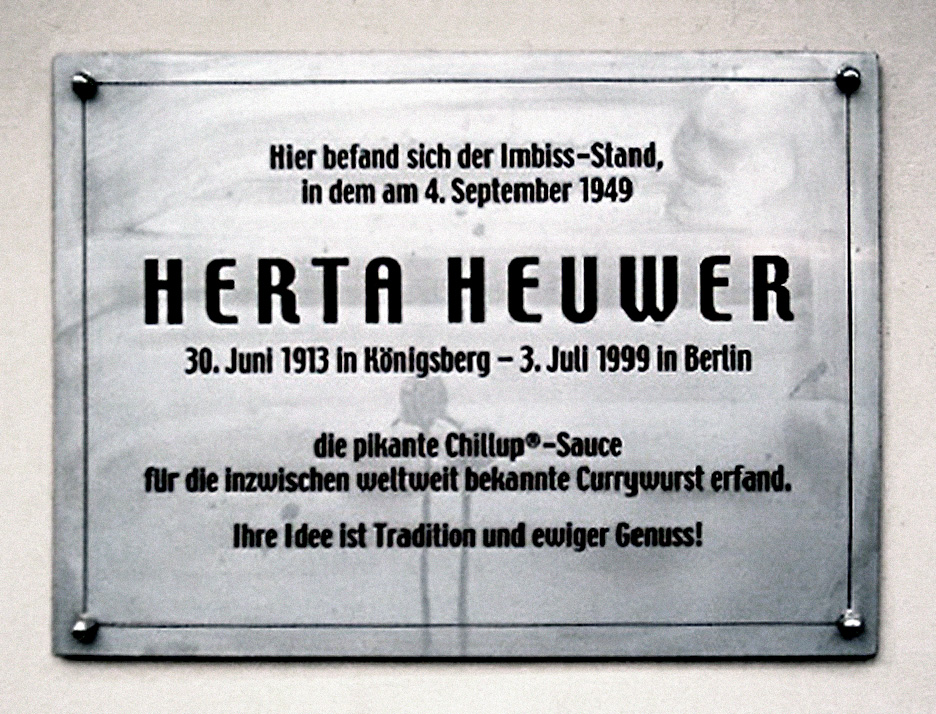
File:Currywurst & Pommes frites.jpgCurrywurst probably owes its existence to British soldiers living and working in Berlin after World War Two. They used curry powder in their own cooking and it is thought that they traded the spicy seasoning with resourceful  German entrepreneur Herta Heuwer. She then put a German spin on the traditional Indian flavours by mixing them with ketchup and serving her creation up with good old German sausage. It has been a firm favourite with young and old ever since.


File:Curry schild.jpg
Here stood the snack stand in which on September 4th 1949 Herta Heuwer invented the spicy
Chillup® sauce for the now world famous Currywurst.


Mittwoch, 4. Juli 2012

Louis Voki


Stop! Hier ist ein Update von Jorvik!

Matthew Voki


Wir singen "Wischi Wischi Waschi Wischi"

Beth and Emily Voki


Und dann unsere Lehrerin, die schaut uns alle an.

Kinder Voki


Wir sehn einen braunen Bären, einen roten Vogel, eine gelbe Ente, ein blaues Pferd, einen grünen Frosch, eine lila Katze, einen weißen Hund, ein schwarzes Schaf, einen goldenen Fisch...