Posts mit dem Label foods werden angezeigt. Alle Posts anzeigen

Dienstag, 3. Dezember 2013

Wort der Woche: Apfel


This ancient fruit is known the world over. Der Apfel ist rund, saftig und süß; round, juicy and sweet.


Used throughout Germany this humble fruit provides refreshing juice (Apfelsaft) and glasses of foaming cider (Apfelmost) and is an important ingredient in many cakes and puddings. One of the most famousof these is Apfelstrudel which is so well known it goes by its German name in many non German-speaking countries.
 © Österreich Werbung, Wolfgang Schardt
 

Apfelstrudel is a Viennese pastry, with a juicy filling made of apples spiced with cinnamon and flavoured with sharp lemon juice and sweet rum. The whole cake is dusted with icing sugar and usually served witha good Austrian coffee. To find out how to make this delicious teatime treat, click here.

Can you work out what this proverb means?
Einen Apfel pro Tag, mit dem Doktor keine Plag.

I think you might have guessed this one. The english version is: An apple a day keeps the doctor away.

Montag, 4. November 2013

Wort der Woche: Mohn


 Vivid red, cheeky scarlet and faded pink, you can see these iconic flowers everywhere in the UK during the first few days of November. Yesterday I saw a huge one in the departures area for rail  passengers to look at while waiting for their trains at London's King's Cross Station. They are worn to remember and honour soldiers who died in WWI and WWII.  The British public have supported the Poppy Appeal since 1918 and money raised is used to help soldiers who have returned from war to adapt to civilian life.


In Germany and Austria poppies have a more everyday use. Many people might eat them with their breakfast or for a mid-morning treat. Poppyseeds or Mohnkörner are used to decorate bread rolls. They look delicious, especially on the small white Mohnbrötchen available to buy in bakers and coffee shops in most towns and villages. The tiny blue-grey seeds look pretty and add crunch and a nutty flavour to the white rolls. They are also sold in butchers shops; just ask for a Käsebrötchen or a Schinkenbrötchen and you will soon be tucking into a roll freshly filled with cheese or ham.


Sonntag, 8. Juli 2012

word of the week: bratwurst

Are you a sausage-lover? If so a trip to Germany is right up your street! There are probably as many types of sausage as there are regions in Germany. Wikipedia lists 36 pages of sausage varieties and each page features a few sub-varieties.

Bratwurst is the most well-known sausage. There are over 40 different recipes for Bratwurst alone. The main ingredient is always chopped meat, usually pork, beef or veal, and flavoured with herbs and spices. The Nürnberger Rostbratwurst is similar in size to a British banger (whereas most German sausages are about twice the size) and is a pork sausage lightly seasoned with marjoram. They are traditionally grilled over a beechwood fire. In a pub they are served on a plate with plenty of delicious sauerkraut and eye-watering horseradish.

File:Bratwurst Glöckl.jpg


If you are in a hurry you can buy them from a street vendor at an Imbißstube. They are usually sold in threes inside bread rolls, slathered in hot German mustard.

File:Drei im Weggla.jpg


Recently Germans have acquired a taste for Currywurst. This is simple and filling fast food, German style. One pork sausage, steamed then fried, is cut into slices and served with generous amounts of warm curry ketchup. This is simply what it sounds like - tomato ketchup blended with curry powder. The Currywurst is usually accompanied by chips or bread rolls.

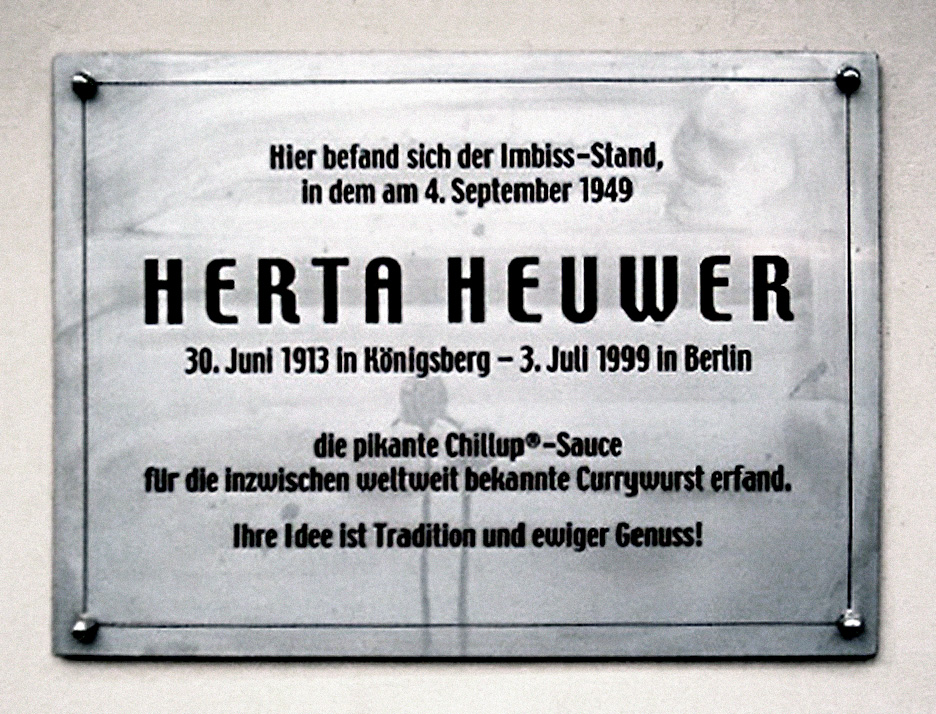
File:Currywurst & Pommes frites.jpgCurrywurst probably owes its existence to British soldiers living and working in Berlin after World War Two. They used curry powder in their own cooking and it is thought that they traded the spicy seasoning with resourceful  German entrepreneur Herta Heuwer. She then put a German spin on the traditional Indian flavours by mixing them with ketchup and serving her creation up with good old German sausage. It has been a firm favourite with young and old ever since.


File:Curry schild.jpg
Here stood the snack stand in which on September 4th 1949 Herta Heuwer invented the spicy
Chillup® sauce for the now world famous Currywurst.


Freitag, 29. Juni 2012

wort der woche: Honig


If you like your food you probably already know that Honig, the food of kings and paupers, is honey. The sweet treat that comes from the Honigbiene (honeybee) is an essential ingredient in a Honigkuchen and on Honigbrot.

Honiggelb is a warm shade of yellow, the colour of Honigwabe. You could find a piece of Honigwabe inside a beehive. It is made up of tiny hexagonal cells which the Queen bee lays her eggs inside. Have you worked out what it is yet? Too right, it's honeycomb!

And one last word. If you are grinning like a Cheshire cat (like the cat in Alice in Wonderland whose smile remained even after it had gone), then the Germans say du grinst wie ein Honigkuchenpferd (you are grinning like a honeycake-horse). I suppose if you were a honeycake-horse you'd have quite a lot to grin about.

Mittwoch, 16. Mai 2012

battenbergkuchen

Many of us have tasted the sweet, almond-infused delights of Battenberg Cake. The distinctive sponge, coloured pink and yellow, has an outer shell of marzipan.

It was created by British chefs in 1884 to honour the wedding of Viktoria von Hessen-Darmstadt (Queen Victoria's grand-daughter) to Prince Ludwig Alexander von Battenberg. The four pink and yellow squares in the cake represent the Battenberg Princes Ludwig Alexander, Alexander Joseph, Heinrich Moritz and Franz Joseph.

During World War One anti-German feeling grew in Britain and Prince Ludwig von Battenberg changed his name to Mountbatten. The cake continued to be called Battenberg and thanks to Mr Kipling and his exceedingly good team it remains a popular tea-time treat today.

Next week chefs in Year 5 will be following a German recipe for Battenberg cake and creating their own versions to be frozen and kept for the Jubilee picnic to be held at school in June. 

Dienstag, 15. Mai 2012

wort der woche: pumpernickel

A dark, chewy, moist and slightly sweet mouthful is Pumpernickel. A very German treat, and some say it is an acquired taste. The bread is made with coarse rye flour and its dark colour comes from a very long baking time.

In the USA Pumpernickel has become popular and is usually sweetened and darkened with cocoa powder, molasses or coffee. In the States and parts of Europe the bread is available in delis and chic eateries, although in Germany and Poland it is still everyday fare. Here in the UK it can be bought at German supermarkets like Lidl and Aldi.

Pumpernickel tastes delicious on its own, toasted, or with cheese, cold meats, smoked salmon. To make your own version of the bread try the recipe by Deb from Smitten Kitchen.

Montag, 30. April 2012

wort der woche: mohnbrötchen


If you happen to be in Germany for breakfast and are offered Mohnbrötchen then snap them up. They are tasty white bread rolls (Brötchen) sprinkled with poppy seeds (Mohn) and are often eaten at breakfast spread with jam (Marmelade) or Nutella. Many Germans prefer a savoury start to the day and take their Brötchen with ham (Schinken) or cheese (Käse). In Austria and southern Germany these rolls are known as Semmel.
As well as Mohnbrötchen you may see weiche Brötchen on the menu. These are soft rolls and much easier to chew. What do you think is sprinkled onto a Sesambrötchen?

Can you spot any of these delicious morsels in the picture below?


Orangensaft
Käse
Müsli
Tee
Kaffee
Joghurt
Honig
ein gekochtes Ei
Tomatensaft
Knäckebrot
Äpfel

Montag, 11. Juli 2011

Word of the Week: Spaghettieis


Spaghettieis is a German-invented ice cream, a cool concoction that looks like a plate of spaghetti bolognese. Created in the 1960s in Mannheim, it is not very well known outside Germany. The white ice cream is squeezed through a press so that it resembles spaghetti, before being topped with strawberry sauce and grated almonds or white chocolate shavings to represent parmesan cheese.

What do you think? Would you try some?

Dienstag, 10. Mai 2011

Word of the Week: Schnecken

This is one of those words which can have more than one meaning (in other words it's a homonym!)
Schnecken are small gastropods that carry round their own shells for protection and shelter. Birds feast on them and if they survive they love to nibble on dainty lettuces and other garden morsels.


The other kind of Schnecken is a delicacy that most people find irresistible. They are cinnamon flavoured buns that are eaten with coffee, and can be bought in the bakery or made at home. Leckere Schnecken! One just isn't enough!

Donnerstag, 7. April 2011

Year Two


These booklets were beautifully illustrated by the brilliant brains in year 2 after they had read and made sense of the German text.


.

Was frisst die kleine Raupe? (What does the little caterpillar eat?)


die kleine Raupe foods.ppt Download this file
On this powerpoint you can see all the different foods that the hungry little caterpillar ate.

Die kleine Raupe

Caterpillar2
  You can listen to a shortened version of Die kleine Raupe here.
 

Die kleine Raupe von Eric Carle.MP3 Listen on Posterous